
Local UK flexible-payment business. Rebuilt Meta Ads from chaotic campaigns and duplicated conversions into a clean, predictable lead-generation system - engineered for qualified leads, not inflated metrics.
Local flexible-payment retailer · Wellingborough, UK - name hidden at the client's request.
The client is a local UK business offering flexible weekly and monthly payment plans on appliances, furniture and home electronics - where the customer owns the product at the end of the plan. Its core audience is people who may struggle to purchase through standard credit-based services because of their credit history, which makes lead quality the critical factor, not just volume.
The business operates within a strict local radius around Wellingborough. Any geo-targeting mistake directly hurts lead quality - leads from outside the service area never convert.
This is lead generation for a narrow audience with specific financial needs, not standard e-commerce. Some leads inevitably drop off - incomplete applications, no-shows, changed minds. "Cheap leads at any cost" doesn't work here. The real challenge is filtering intent and maximizing the share of leads that actually convert into deals.
The ad account had fundamental problems - broken tracking, duplicated conversions, and campaigns optimized for the wrong objective. The client was getting leads, but their quality and economics were unstable.
The "before" tracking was duplicating - sometimes tripling - conversions, so these reported figures were inflated. The real cost per genuine lead was higher than £4.53.
To a sustainable level for the client's unit economics.
While maintaining quality and relevance.
The client was specifically unhappy with the quality of incoming applications before our involvement.
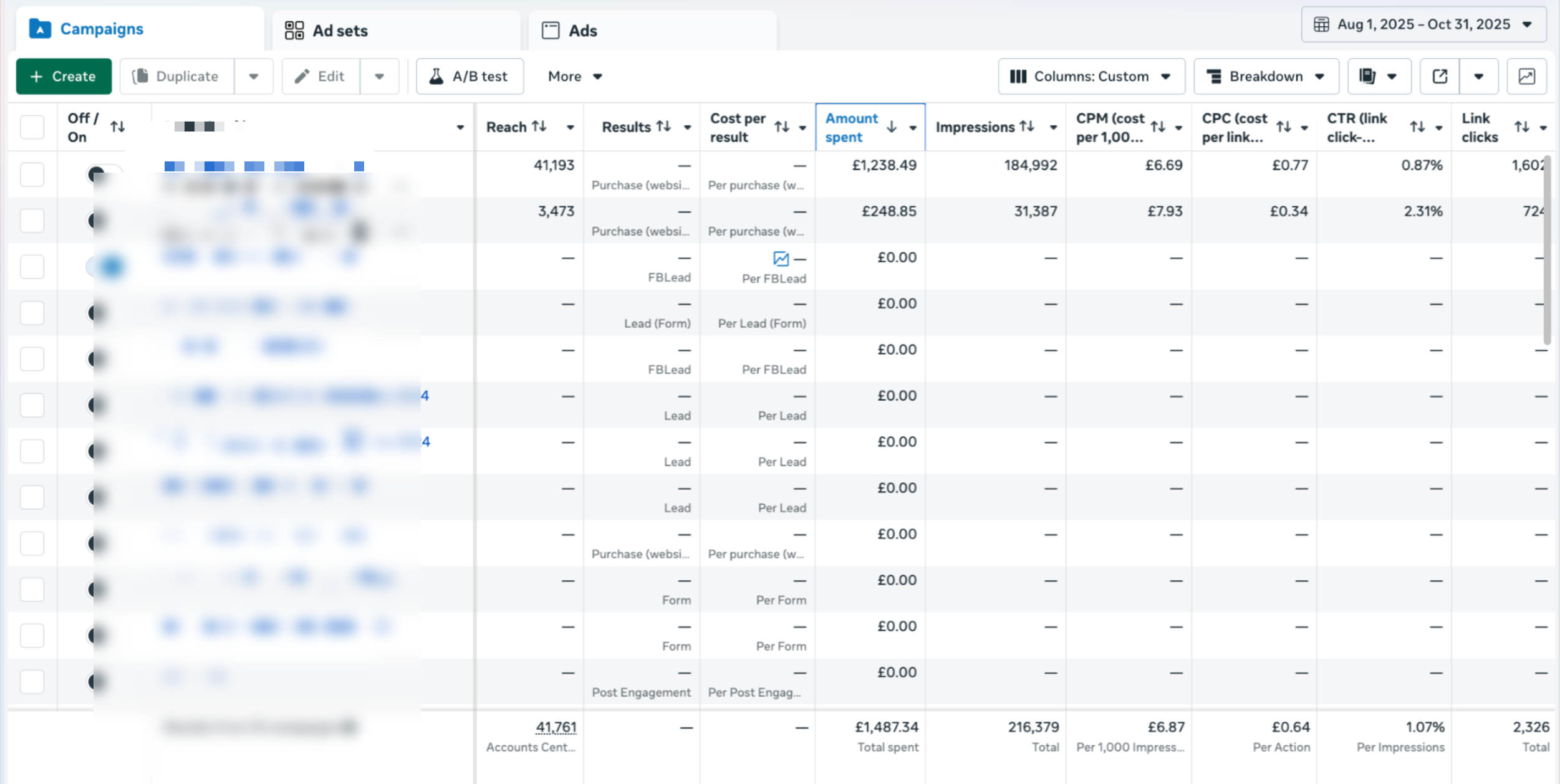
Meta Ads Manager - Aug 1 – Oct 31, 2025. Account overview before our involvement.
The audit found problems that went deeper than "expensive leads." The foundation itself was broken.
Wrong campaign objective. Lead-generation campaigns were optimized for Purchase, not Leads - so Meta was learning toward the wrong action entirely.
Broken pixel & duplicated conversions. Tracking was misconfigured and events were firing multiple times (sometimes tripled), making the reported data unreliable - and the cost metrics look artificially good.
Chaotic campaign structure. No clear logic across campaigns, which made optimization and budget allocation nearly impossible.
No audience filtering. Missing segmentation and geo controls let in low-quality, out-of-area traffic.
Before anything could be optimized, the signals had to be trustworthy - you can't improve what you can't measure.
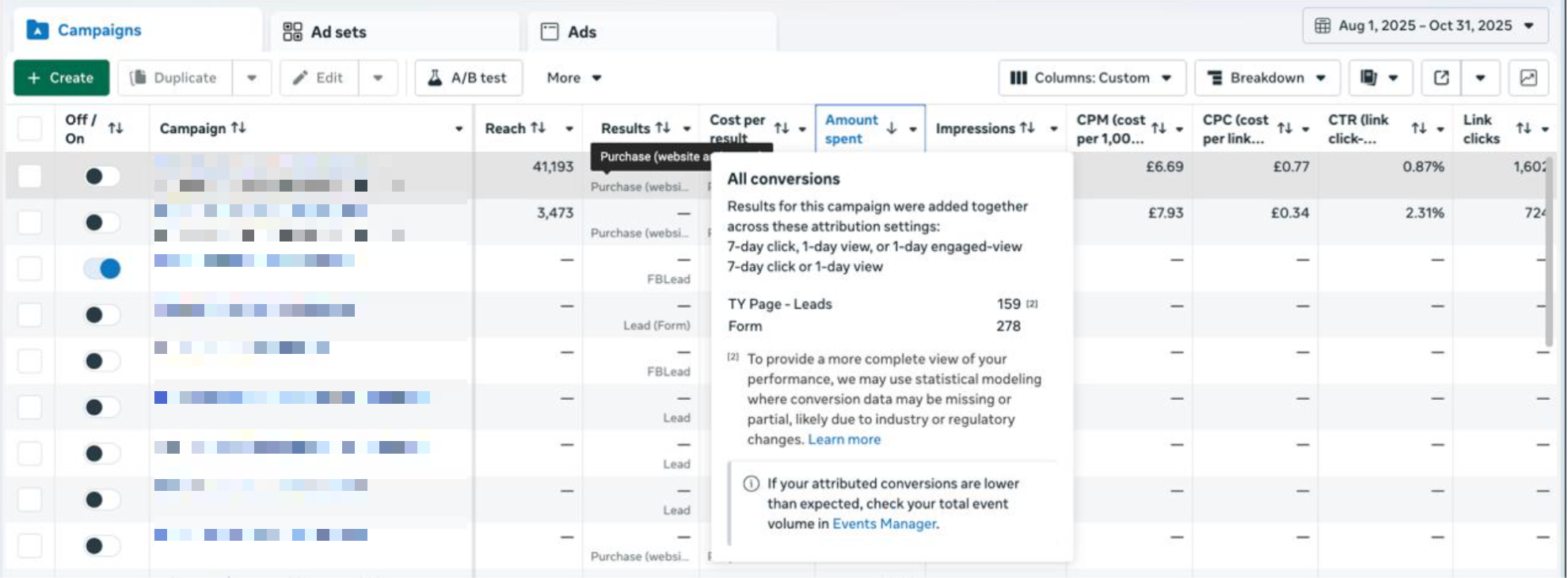
Conversion breakdown - one campaign's results counted both "TY Page – Leads" (159) and "Form" (278): the same lead tracked twice.
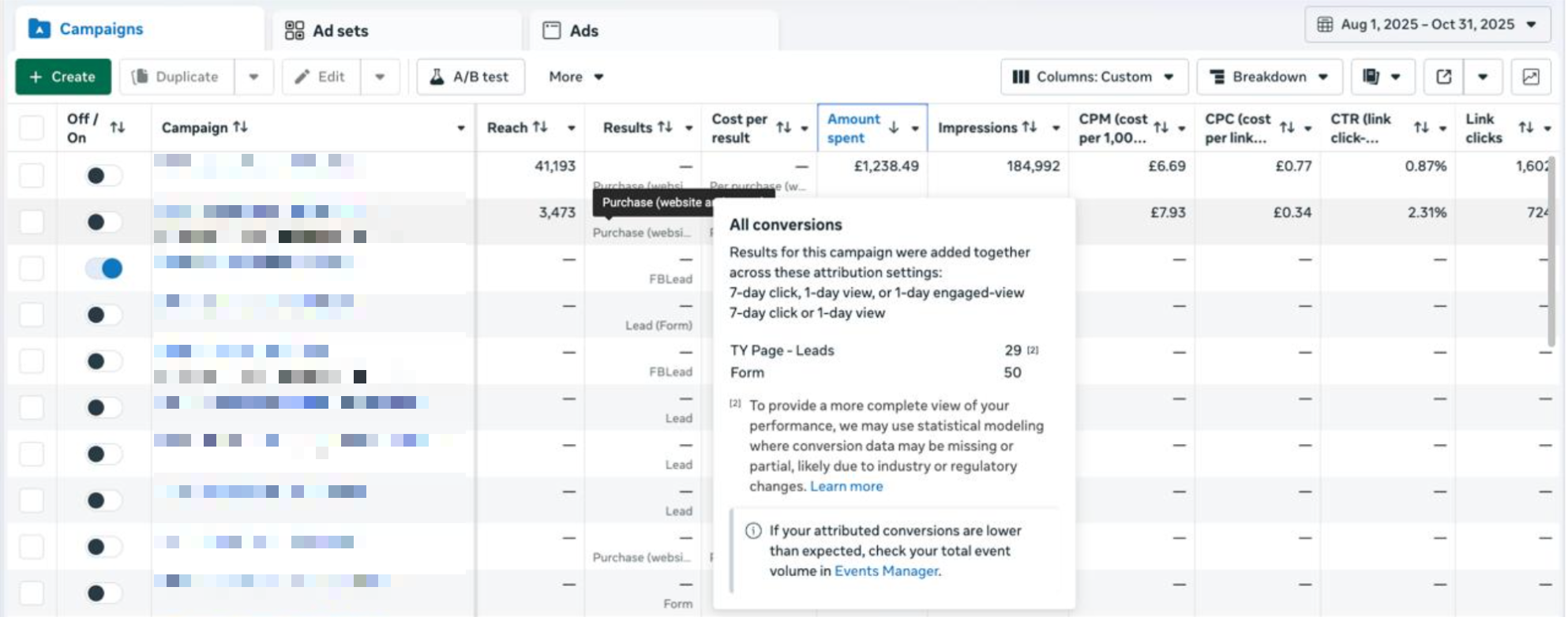
The same duplication on another campaign (29 + 50). Across the account this inflated the reported lead count and made CPL look artificially low.
Every change below was aimed at increasing the quantity but above all the quality of leads. One constraint shaped how: there was no CRM in place yet. I made the case early that a CRM is essential - it's how you feed Meta clean, closed-lead signals to learn from. The client wasn't ready for that step at the time, so we worked with what we had: quality was tracked the hands-on way - through the client's direct feedback on incoming applications plus manual review - and optimization decisions were driven by that feedback loop, not platform metrics alone.
Rebuilt lead tracking through GTM from scratch. Eliminated duplicate events and made sure Meta learned from real form submissions (FBLead), not inflated data. This was the foundation - without accurate signals, no amount of campaign optimization produces reliable results.
With a limited budget, I removed top-of-funnel campaigns and concentrated entirely on lead generation. That accelerated the accumulation of clean conversion data and sped up campaign learning. The account was rebuilt into one campaign with three category ad sets, with budget flowing dynamically to whichever performed cheapest - so spend always followed the data.
Tested universal banners against product-specific creatives. Product-focused banners filtered the audience far better and attracted more motivated users, and adding price points directly onto the visuals improved lead quality further - people who clicked already understood the offer. Creative was treated as a continuous lever, not a one-off: budget-hungry creatives that didn't convert were paused and reallocated, and the ad set was refreshed whenever engagement started to fatigue.
Systematic work on audiences: cut weak segments, strengthened the most relevant user groups, and removed irrelevant geographies - which directly improved incoming traffic quality. When the client flagged weaker leads, I tightened audiences even at the cost of short-term volume, because in this niche a smaller pool of qualified applications beats a flood of cheap, irrelevant ones.
Adjusted the strategy for seasonal demand shifts. During the festive period the focus was on electronics; after the holidays it shifted to appliances and furniture. That flexibility kept a stable lead flow across the whole period.
A 3-month comparison against the same period before our involvement. "After" numbers reflect real data with corrected tracking (FBLead events only), not inflated metrics.
"Before" numbers use Form leads only (tracking was duplicating events); "After" numbers use the FBLead events we configured - clean, unduplicated data. Because the old tracking inflated the lead count, the −12% is conservative: against genuine leads, the real cost dropped further. Traffic cost barely moved (CTR / CPC / CPM flat) - the gains came from a correct objective, clean tracking and better creative, not cheaper clicks.
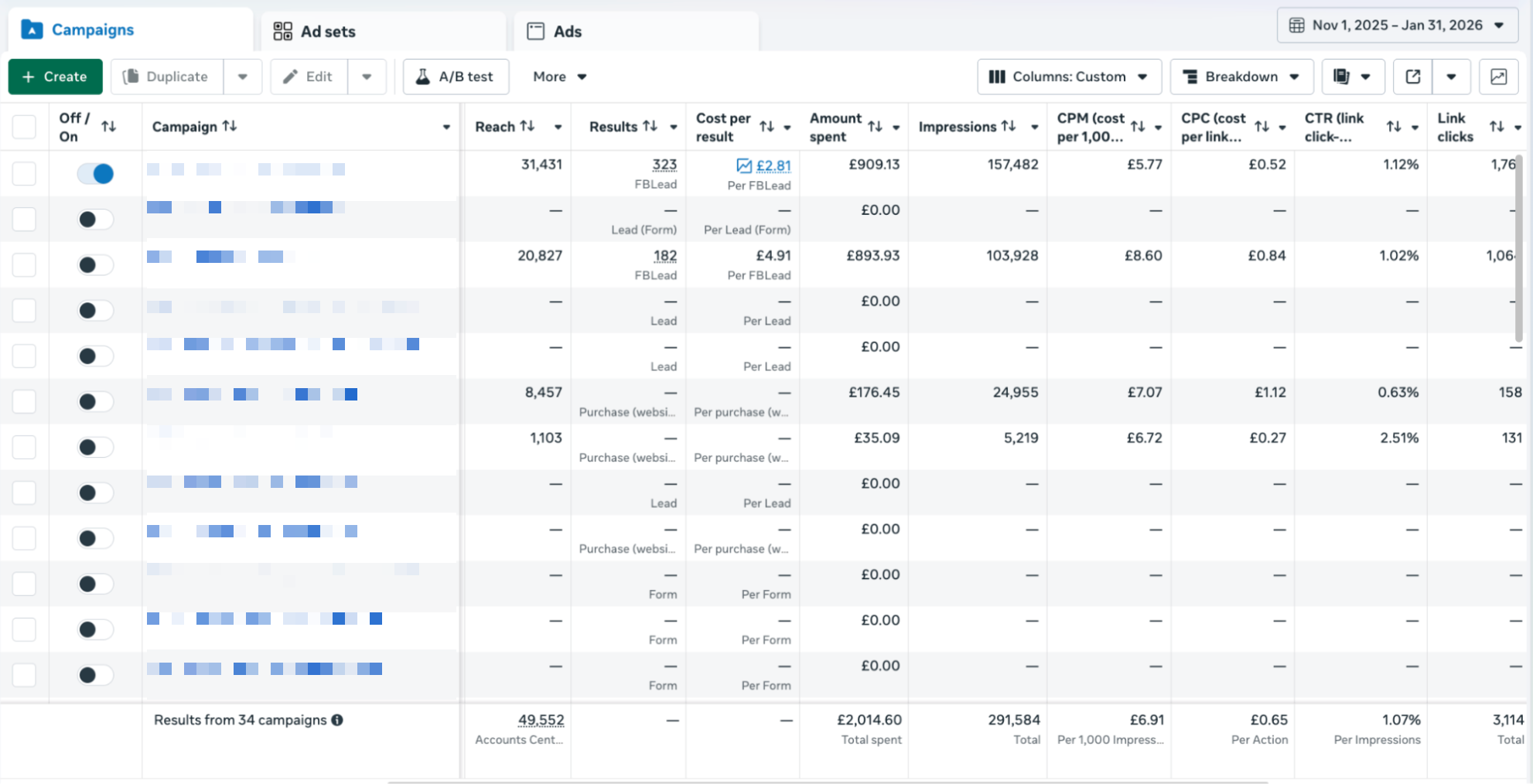
Meta Ads Manager - Nov 1, 2025 – Jan 31, 2026. 505 leads at £3.99 avg CPL with corrected tracking.

Meta Ads Manager - Jan 26 – Feb 1, 2026. 84 leads at £2.10 cost per lead, the best week of the launch period.
A slight CPL rise right after this peak wasn't declining performance - the client reduced the daily budget, which naturally affects algorithm stability. The trend held: cost per lead keeps falling as the campaigns learn.
In mid-May 2026, a fresh creative batch lifted weekly leads from 23 to 73 (+217%) and pushed CPL down to £1.71 - with the Technology ad set alone delivering leads at ~£1.09. That's the clearest proof this is a durable, scalable system, not a one-off spike.
Cheaper leads only matter if they're the right people. A CRM would verify that automatically - and I recommended one - but until the client is ready for it, quality was verified directly: through the client's feedback and manual review of incoming applications, with audiences tightened around that feedback. On-site behaviour backed it up - visitors from the ads were spending meaningful time engaging with the site, a signal that the incoming traffic was relevant and in-market, not idle browsers.
When I started, the advertising was running chaotically and producing unreliable data: lead-generation campaigns optimized for Purchase, a misconfigured pixel, and conversions duplicated - sometimes tripled. The client was getting leads, but their quality and economics were unstable.
I rebuilt everything from the foundation up. First I fixed tracking through GTM so Meta could finally learn from real form submissions instead of inflated data. Then I restructured the account to focus purely on lead generation, cut top-of-funnel spend that wasn't contributing, and built a clean three-category structure with budget flowing to the strongest performer.
Clean data beats more data. The "before" numbers were inflated by duplicated tracking, so the real starting point was worse than it looked. Rebuilding tracking through GTM meant every later decision rested on real form submissions, not noise.
Right objective, right structure. Switching campaigns from Purchase to Leads and running three category ad sets - with budget flowing to the cheapest performer - turned a chaotic account into a predictable, manageable system.
Creative is the lever. Product-specific banners with prices on the visual filtered intent far better than generic creative - and an ongoing refresh cycle drove CPL from £7.52 at launch to £2.10, then to £1.71 with fresh creatives.
A CRM is the next step up. Quality here is capped by data: without closed-deal feedback flowing back to Meta, the algorithm can only optimize toward form-fills, not customers. I flagged the integration early - and until the client is ready for it, optimization runs on their direct feedback and manual review of every application. That was enough to drive CPL down to £1.71 and lift lead quality, with clear headroom once the CRM is in place.
"I rebuilt a chaotic account from the tracking up - so the numbers finally told the truth, and the cost per lead has been falling ever since."
Tell me about your business and goals. I'll show you honestly whether paid ads can get you there - and what it would take.
Discuss your project →