
Local UK business on a flexible pay-weekly / pay-monthly model. I rebuilt unmanaged Google Ads into a predictable local lead-generation system - Search + Performance Max - engineered for qualified, closing leads, not just cheap leads.
Local flexible-payment retailer · Wellingborough, UK - name hidden at the client's request.
The client is a local UK business offering flexible weekly and monthly payment plans on home appliances and electronics - washing machines, TVs, gaming, phones, furniture and more - where the customer owns the product at the end of the plan. Free delivery, no setup fees, no hidden charges; authorised and regulated by the FCA.
Its core audience is people who may struggle to access standard credit-based purchasing - which makes lead quality the critical factor, not just volume.
This isn't standard e-commerce - it's lead generation for a very specific audience. Some leads inevitably drop off: incomplete applications, no-shows after first contact, changed minds. "Cheap leads at any cost" doesn't work here. The real challenge is filtering intent and cutting irrelevant traffic so a higher share of leads actually converts into signed agreements.
Campaigns had been running for a while but without systematic optimization. They were producing conversions - but the client was specifically unhappy with lead quality: too many applications from outside the service area, the wrong intent, or people who never completed the process.
To a sustainable level for the client's unit economics.
While maintaining relevance and manageability.
The client was specifically unhappy with the quality of incoming applications - the metric that actually matters here.
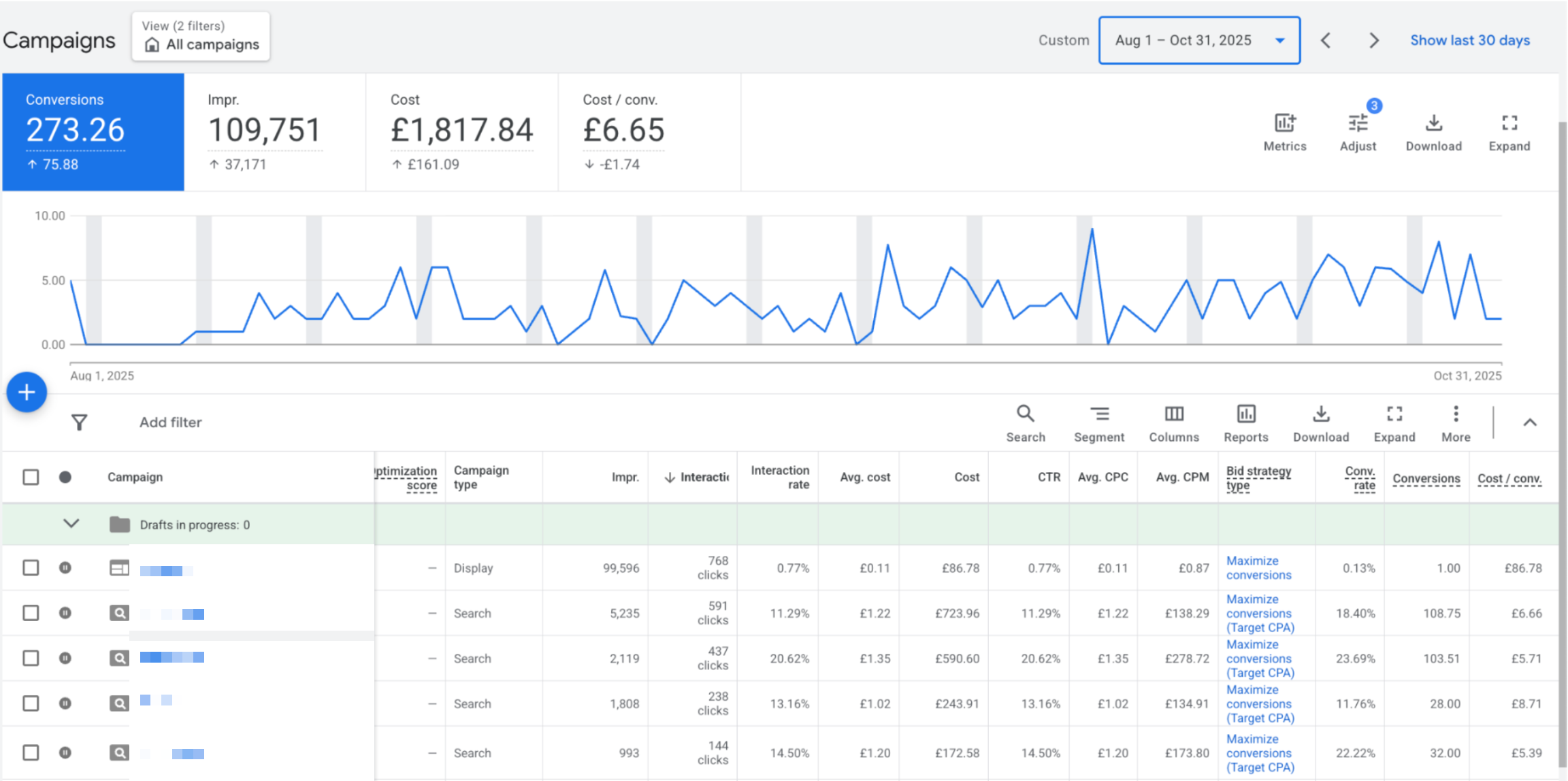
Google Ads overview - Aug 1 – Oct 31, 2025. 273 conversions at £6.65 cost/conv. Before systematic optimization.
The conversions looked cheap, but they were often the wrong people - out-of-area, wrong intent, unqualified. The audit found four structural causes.
Weak search term control. Insufficient negative keywords meant budget was leaking into irrelevant queries.
Overloaded structure. Too many entities without clear logic, making it hard to manage category priorities and causing budget to scatter.
Mismatched intent. Part of the keyword set didn't align with the flexible-payment model, attracting users looking for standard outright purchases.
Geo leakage. Traffic and interactions were coming from irrelevant locations - critical for a business with a strict local radius.
The account was optimized to generate conversions, not qualified applications. Fixing that meant rebuilding for intent and geo precision.
Every change below was aimed at increasing the quantity but above all the quality of leads. One constraint shaped how: there was no CRM in place yet. I made the case to the client early that a CRM is essential - it's how you collect clean lead-quality data and feed the algorithm the signals it needs to learn which leads actually close. The client wasn't ready for that transition at the time, so we worked with what we had: quality was tracked the hands-on way - through the client's own feedback plus manual review - and every decision was driven by that feedback loop, not platform metrics alone.
Restructured Search into a cleaner, more manageable setup to quickly control intent and clean up queries. Leads started delivering more consistently, and as search terms were refined, cost per conversion gradually decreased.
Tested PMax in parallel with Search - it outperformed on both cost per lead and volume, and became the stable, primary driver of conversions. The focus shifted to making sure PMax's algorithm learned from the right signals: audience signals tied to search-term data, tightened geo control, and creatives designed to filter out irrelevant traffic.
Tested general formats against product-specific creatives - category-specific creatives (individual products and product groups) performed significantly better, producing cleaner intent. Built PMax asset groups by category so performance could be read and steered per product line, aligned to seasonality.
The heart of the project. Rather than chase cheap conversions, I deliberately tightened for qualified leads - and where that meant trading volume for quality, that was the right call for this business.
A 3-month comparison against the same period before our involvement. (Christmas / New Year ads were paused at the client's request.)
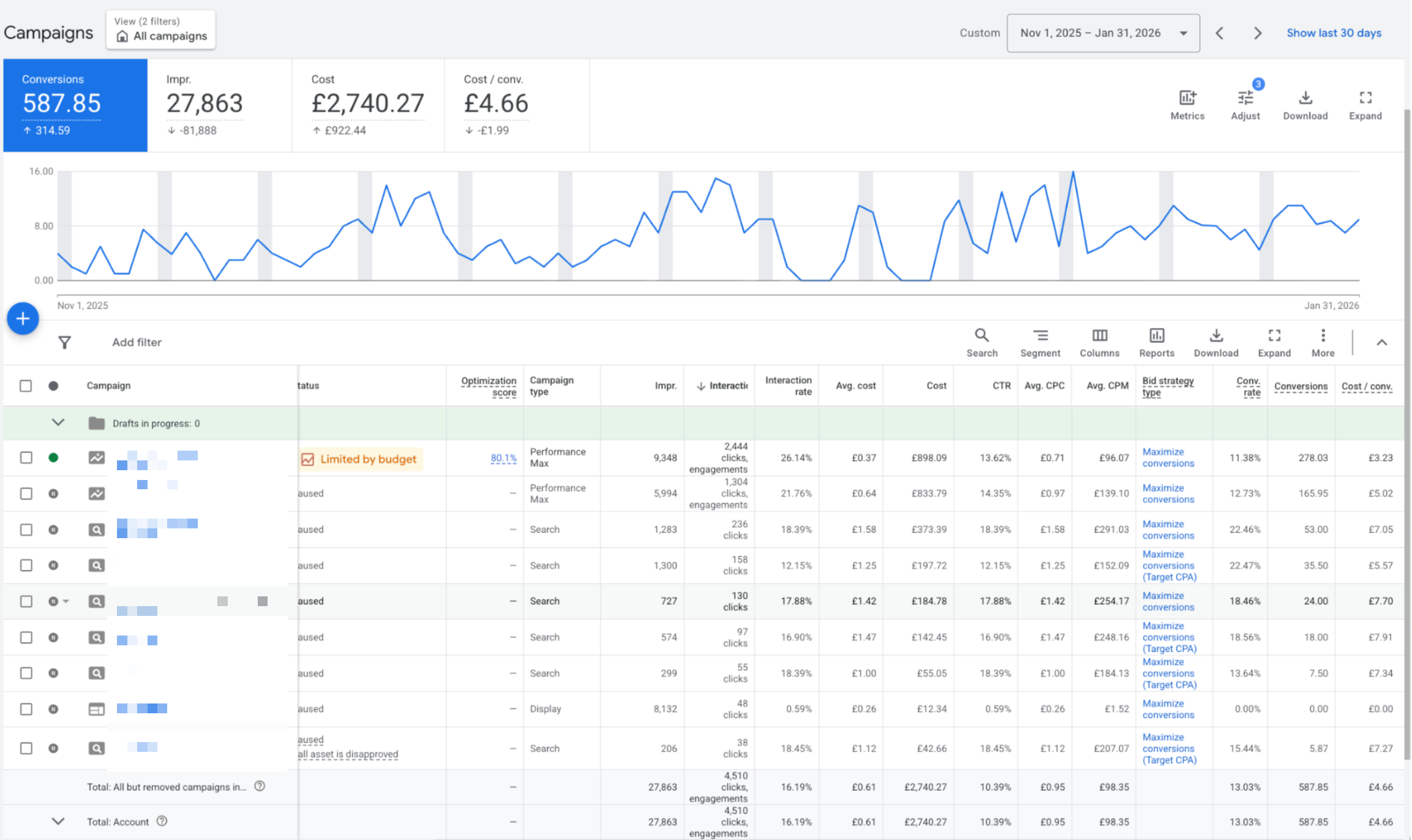
Google Ads overview - Nov 1, 2025 – Jan 31, 2026. 587.85 conversions at £4.66 cost/conv.
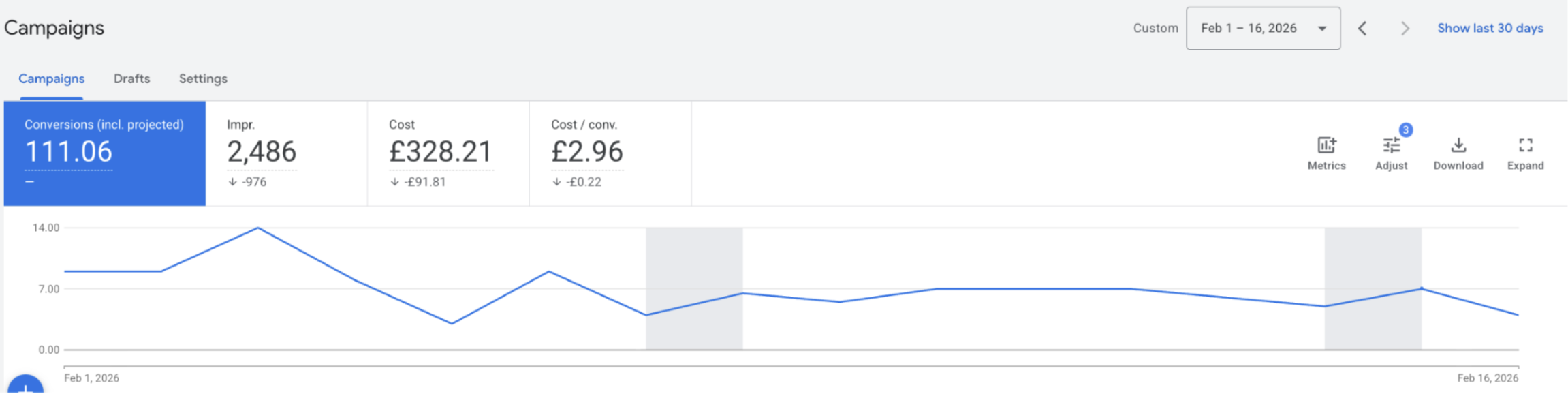
Google Ads - Feb 1–16, 2026. Cost/conv down to £2.96 - the system improving over time, not a one-off spike.
That's a 55% reduction from the pre-work baseline - in 4 months. CPL has held in the ~£3–4 range since, with a brief, expected rise in early March after the words "rent/rental" were removed from ads at the client's request for licensing reasons - relevance on those queries dipped, then recovered with search-term optimization.
Cheaper conversions only matter if they're the right people. A CRM would be the ideal way to verify that automatically - and I recommended one - but the client wasn't ready for that step yet, so quality was verified the direct way: through the client's own feedback and manual review. The client confirmed lead quality improved. By the client's and our own estimate, around 50% more of the incoming leads now move toward signed agreements. GA4 backs the relevance up: average on-site engagement of ~1:15 for Performance Max and ~1:00 for Search - a strong signal that the incoming traffic is genuinely in-market, not curious browsers.
This project was about quality just as much as cost. In a niche where the audience is narrow and a portion of leads naturally drop off, the biggest mistake would be chasing cheap CPL without filtering intent - and with no CRM in place yet, lead quality had to be judged on the client's real feedback.
Cheap leads ≠ qualified leads. In a niche where a big share of applications naturally drop off, chasing low CPL is a trap. The work was about filtering intent so a higher share of leads converts into signed agreements.
Geo precision is non-negotiable. For a strict ~30-mile service radius, out-of-area traffic looks fine on the dashboard and converts to nothing. Tight geo + postcode exclusions protected real lead quality.
A CRM is the next step up. Quality here is capped by data: without closed-deal feedback flowing back to Google, the algorithm can only optimize toward form-fills, not customers. I recommended the integration early - and until the client is ready for it, optimization runs on their direct feedback and manual review of every application. That was enough to cut CPL by 55% and lift lead quality, with clear headroom once the CRM is in place.
Performance Max became the predictable core. Tested against Search, PMax won on cost and volume - and, fed the right signals, became the stable, sole driver of qualified conversions.
"I turned unmanaged campaigns into a predictable local lead-generation system - more conversions, lower cost, and the lead quality the client actually needed."
Tell me about your business and goals. I'll show you honestly whether paid ads can get you there - and what it would take.
Discuss your project →